cd
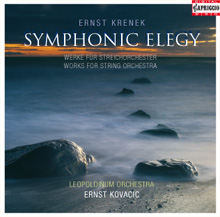
ERNST KRENEK Symphonic Elegy
Orchestra Leopoldinum · Ernst Kovacic
Abschied und Aufbruch – Ernst Kreneks Werke für Streichorchester
Mit seiner Symphonic Elegy, die er bereits im Januar 1946 „in memoriam Anton Webern“ vollenden konnte, leistete Krenek auf beeindruckende Weise Trauerarbeit. Immerhin war es ihm gelungen, ein Werk zu schaffen, das einerseits (in der souveränen Handhabung der Zwölftonmethode) kompositionstechnisch auf der Höhe seiner Zeit stand, andererseits aber von bewegender Espressivität ist, wie etwa der zentrale Teil offenbart: eine an Gustav Mahler gemahnende Marcia funebre, die der perkussiv wiederholte, dem Pizzikato der tiefen Streicher überantwortete Ton d grundiert.
Weniger komplex geht es in Kreneks 1955 geschriebenen Sieben leichten Stücken für Streichorchester zu, wobei „leicht“ nicht allein auf den nicht sonderlich hohen spiel technischen Schwierigkeitsgrad abzielt, sondern auch auf das Leger-Heitere, das den genrehaften Miniaturen eignet.
Die kräftigen Rhythmen der Sinfonietta a Brasileira op. 135 verweisen indes weniger auf Folklorismen als auf den jungen Krenek, der sich in der Phase der Neuen Sachlichkeit gern maschinenhafter Pulsationen bediente. Es scheint als habe der Komponist damals wieder an Bodenhaftung gewonnen und sich von jenen vergeistigten Klängen verabschiedet, mit denen er auf den Zweiten Weltkrieg und das Exil reagiert hatte.
Farewell and Departure – Ernst Krenek’s opus for string orchestra
The composers Symphonic Elegy “in memoriam Anton Webern” which he finalised already in January 1946 is an impressive example of grieving. After all, he has managed to combine on the one hand the sovereign use of twelve-tone music, then a sign of his sound grasp of contemporary composition, and on the other hand he made use of a moving expressiveness, which is especially apparent in the central movement: A Marcia funebre in the tradition of Gustav Mahler, underpinned by a note in D by low-pitched strings in pizzicato mode.
Krenek’s Sieben leichte Stücke (Seven easy/light pieces of music) for string orchestra, composed in 1955 are less complex. However, the classification as easy/light is not only characterising the relatively low level of technical difficulty but the cheerful and casual character of the pieces.
The powerful rhythm of the Sinfonietta a Brasileira op. 135 is not so much borrowed from folkloristic music but more a reference to the work of the young Krenek, who during the phase of Neue Sachlichkeit (New Sobriety) liked to use machine-like pulsation. It seems as if the composer had regained his old fortitude after the years of WWII and his exile which were characterised by refined sounds.
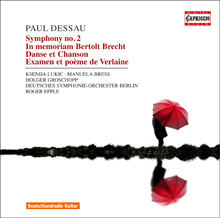
PAUL DESSAU Diapason d'Or
In memoriam Bertolt Brecht (1957)
Symphony No.2 (1934-1962)
Sinfonie in einem Satz (1926)
Examen et poème de Verlaine (1938)
KSENIJA LUKIC · MANUELA BRESS HOLGER GROSCHOPP DEUTSCHES SYMPHONIE-ORCHESTER BERLIN ROGER EPPLE
PAUL DESSAU
Paul Dessau (1894-1979) war neben Hanns Eisler der bekannteste Komponist der DDR. Trotzdem wird man seinem umfangreichen Schaffen nicht gerecht, wenn man ihn auf die Rolle des regimetreuen Staatskomponisten reduziert. Dessau stammte aus einer musikalisch geprägten jüdischen Familie in Hamburg; sein Vetter war der Operettenkomponist Jean Gilbert. Ursprünglich wollte Dessau Dirigent werden, hatte jedoch seit Mitte der 20er Jahre soviel Erfolg mit seinen Kompositionen, dass das Dirigieren in den Hintergrund trat. Unter dem Eindruck des Ersten Weltkriegs, des Nationalsozialismus und schließlich eines weiteren vernichtenden Krieges bildete sich Dessaus politische Überzeugung heraus, dass nur der Kommunismus zu einer humanen Gesellschaft führen konnte. Die Entscheidung, in der DDR zu leben, muss vor diesem Hintergrund gesehen werden. Dessaus kompositorisches Werk umfasst nahezu alle Gattungen vom Klavierstück über Kammermusik, Lieder und Chorwerke bis hin zur großen Oper.
Together with Hanns Eisler, Paul Dessau (1894-1979) was the leading composer of the German Democratic Republic. Nevertheless, it is not possible to reduce him to a state composer loyal to his regime. Dessau was born in Hamburg and was part of a musically active Jewish family; his cousin was famous operetta composer Jean Gilbert. Oroginally, Dessau wanted to become a director. During the mid-twenties he was that successful with his own composition that no time remained for directing. His political credo was formed and influenced by the first World Was, the Nazis and a further, devastating war. He believed that only communism leads to a humane society. This is why he decided to live in the German Democratic Republic. Dessau’s compositorial work comprises all kinds of classic music, from piano to chamber music, lieder, works for choirs and also great operas.
Paul Dessau (1894 – 1979) était le compositeur le plus connu de la RDA, avec Hanns Eisler. Toutefois, on ne rend pas justice à son œuvre étendue en le réduisant à un compositeur d’Etat conforme au régime. Dessau est issu d’une famille juive d’Hambourg, qui s’intéresse à la musique; le compositeur d’opérette Jean Gilbert était son cousin. Initialement, Dessau eut l’intention de faire carrière en tant que chef d’orchestre, cependant, à partir de la moitié des années 1920, ses compositions eurent un tel succès, que l’autre activité passa au second plan. Sous la pression de la Première Guerre Mondiale, du nazisme et, enfin, d’une autre guerre destructive, Dessau conclut que seulement le communisme pouvait mener vers une société humaine. De ce point de vue il faut comprendre sa décision de vivre en RDA. Les compositions de Dessau comprennent presque tous les genres, du morceau de piano, à la musique de chambre, en passant par des Lieder et des œuvres chorales jusqu’au grand opéra.
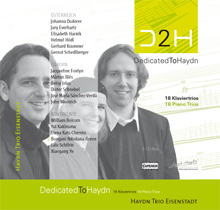
D2H - Dedicated To Haydn
18 Musical Statements from international Composers
(Austria / Europe / USA / Australia / Argentinia / Japan / China)
Anlässlich des 100. Todesjahres Joseph Haydns entstand im Jahre 1909 auf Initiative einer der damals führenden, französischen Musikzeitschriften — „Revue musicale mensuelle de la S.I.M.“ — ein Kompositionsprojekt der 6 französischen Komponisten Maurice Ravel, Claude Debussy, Paul Dukas, Reynaldo Hahn, Vincent d’Indy und Charles Widor.
Der Grund: eine Hommage à Joseph Haydn, 6 Kompositionen für Klavier, in Auftrag gegeben von Jules Écorcheville.
Nun entstand für 2009 anlässlich des 200. Todesjahres ein diesem Gedanken folgendes, aber viel weitreichenderes Kompositionsprojekt: D2H – DedicatedToHaydn.
In Zusammenarbeit mit den Haydn-Festspielen Eisenstadt wurde die Idee von 1909 als Ausgangspunkt genommen und 18 KomponistInnen verfassten „musikalische Statements“ über Joseph Haydn und seine Musik: 6 lebende KomponistInnen aus Österreich, 6 aus Europa und weitere 6 von verschiedenen Kontinenten (USA / Australien / Japan etc.) Harald Kosik, Pianist des Haydn-Trios Eisenstadt übernahm die Konzeption und Projektleitung.
Die 18 neuen Werke beziehen sich auf einen Aspekt aus dem Leben oder der Arbeit von Joseph Haydn. Auf ihre ganz unterschiedliche, nicht zuletzt auch kulturell geprägte Art und Weise gedenken die KomponistInnen Joseph Haydns und widmen ihm ihr neues Werk.
Die Dauer der neuen Werke ist auf 7-10 Minuten begrenzt.
Österreich
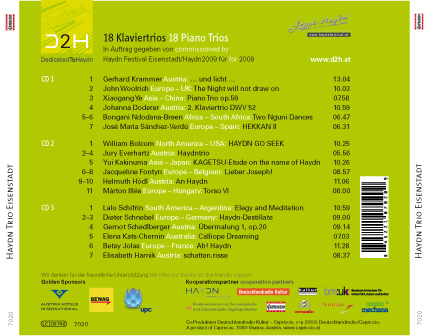
Johanna Doderer: „2. Klaviertrio DWV 52“
Jury Everhartz: „Haydntrio“
Elisabeth Harnik: „schatten.risse“
Helmuth Hödl: „An Haydn“
Gerhard Krammer:„...und Licht…“
Gernot Schedlberger: „Übermalung 1, op.20 für Klaviertrio“
Europa
Jacqueline Fontyn, Belgien: „Lieber Joseph!”
Márton Illés, Ungarn: “Torso VI”
Betsy Jolas, Frankreich: „Ah! Haydn”
Dieter Schnebel, Deutschland. „Haydn-Destillate“
José María Sánchez-Verdú: „HEKKAN II“
John Woolrich, UK: „The Night will not draw on“
Kontinente
William Bolcom, USA: „Rondo: HAYDN GO SEEK“
Elena Kats-Chernin, Australien: „Calliope Dreaming“
Yui Kakinuma, Japan: „KAGETSU -Etude on the name of Haydn”
Bongani Ndodana-Breen: „Two Nguni Dances“
Lalo Schifrin, Argentinien: „Elegy and Meditation“
Xiaogang Ye, China: „Piano Trio, op.59”
On the occasion of the 100th anniversary of the death of Joseph Haydn in 1909, six French composers, Maurice Ravel, Claude Debussy, Paul Dukas, Reynaldo Hahn, Vincent d’Indy, Charles Widor were invited by the then leading French magazine for music, the-„Revue musicale mensuelle de la S.I.M.“ to participate in a composition project.
The reason: A “Hommage à Joseph Haydn”, six compositions for piano, commissioned by Jules Écorcheville.
Now in 2009, on the occasion of the 200th anniversary of Haydn’s death, the following far more extensive composition project has been launched: D2H – DedicatedToHaydn
In co-operation with the Haydn-Festival Eisenstadt the original idea from 1909 was adapted and 18 contemporary composers invited to author a „musical statement” on Joseph Haydn and his music. Six Austrian composers, six from Europe, another six from various parts of the world (USA / Australia / Japan et al.) worked under the conceptual leadership of project manager Harald Kosik, pianist with the Haydn-Trio Eisenstadt.
Each of the 18 new compositions focuses on one aspect of Joseph Haydn’s life or work. The composers dedicated their works to Joseph Haydn and commemorate him in very distinctive ways, influenced by their individual cultural background.
The duration of the works has been limited to 7-10 minutes each.
Austria
Johanna Doderer: „2. Klaviertrio DWV 52“
Jury Everhartz: „Haydntrio“
Elisabeth Harnik: „schatten.risse“
Helmuth Hödl: „An Haydn“
Gerhard Krammer:„...und Licht…“
Gernot Schedlberger: „Übermalung 1, op.20 für Klaviertrio“
Europe
Jacqueline Fontyn, Belgien: „Lieber Joseph!”
Márton Illés, Ungarn: “Torso VI”
Betsy Jolas, Frankreich: „Ah! Haydn”
Dieter Schnebel, Deutschland. „Haydn-Destillate“
José María Sánchez-Verdú: „HEKKAN II“
John Woolrich, UK: „The Night will not draw on“
World
William Bolcom, USA: „Rondo: HAYDN GO SEEK“
Elena Kats-Chernin, Australien: „Calliope Dreaming“
Yui Kakinuma, Japan: „KAGETSU -Etude on the name of Haydn”
Bongani Ndodana-Breen: „Two Nguni Dances“
Lalo Schifrin, Argentinien: „Elegy and Meditation“
Xiaogang Ye, China: „Piano Trio, op.59”
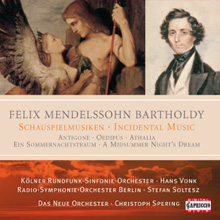
SCHAUSPIEL MUSIKEN INCIDENTAL MUSIC
Antigone · Oedipus · Athalia
A Midsummer Night’s Dream
Otto Sander · René Pape · Rundfunkchor Berlin · Radio-Symphonie-Orchester Berlin · Stefan Soltesz · Chorus Musicus Köln · Das Neue Orchester · Christoph Spering
Jeder kennt den Hochzeitsmarsch aus Mendelssohns Musik zu Shakespeares “Sommernachtstraum”, aber kaum einer weiß, dass diese Musik im Zusammenhang steht mit den Bemühungen des preußischen Königs Friedrich Wilhelm IV., im 19. Jahrhundert Berlin zu einer Kulturmetropole zu machen. Er beorderte Mendelssohn nach Berlin und ließ ihn die Musik zu Aufführungen griechischer Tragödien (Antigone, Ödipus), französischer Schuldramen um Figuren aus dem Alten Testament (Athalia) oder eben eine Komödie von Shakespeare (Ein Sommernachtstraum) schreiben. Mendelssohn war bald unzufrieden mit den Arbeitsbedingungen und kehrte Berlin enttäuscht den Rücken – seine Musik aber bleibt bestehen. In diesem 4-CD-Set sind die vier Schauspielmusiken komplett vereint.
Everybody knows the Wedding March from Mendelssohn’s music to Shakespeare’s “Midsummer Night’s Dream”, but few know that this music is connected with the efforts of the Prussian king Friedrich Wilhelm IV to turn 19th century Berlin into a center of the arts. He summoned Mendelssohn to Berlin and commissioned him to write the music to performances of Greek tragedies (Antigone, Oedipus), French classical drama drawn from the Old Testament (Athalia) and a comedy by Shakespeare (A Midsummer Night’s Dream). Mendelssohn soon grew discontented with his working conditions and turned his back on Berlin, but his music survived him. This 4 CD set contains the entire stage music to the four plays.
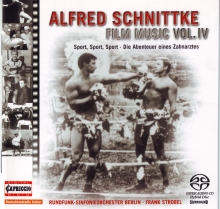
ALFRED SCHNITTKE - Film Music Vol. IV
Rundfunk-Sinfonieorchester Berlin · Frank Strobel
Elektrisch verstärkte Gitarre, Celesta, präpariertes Klavier und drei Bongos eröffnen die Suite der Musik zur Körperertüchtigungssatire "Sport, Sport, Sport". Unkommentiert basteln der Regisseur Elem Klimow und Schnittke eine gutmütige Karikatur auf all die sich ehrgeizig Bewegenden.
Electrically amplified guitars, celestas, prepared pianos and three bongos open the suite from the music to the satire on fitness: "Sport, Sport, Sport". Movie director Elem Klimow and Schnittke put together a good-humored caricature of the ambitious movers.