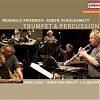
cd

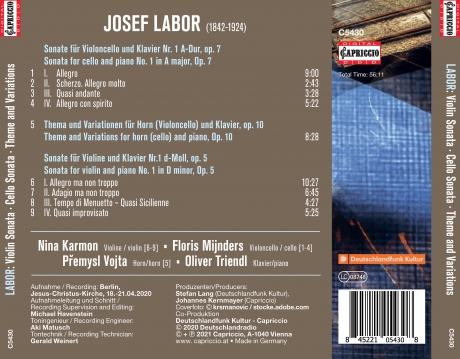
JOSEF LABOR (1842-1924)
Nina Karmon · Floris Mijnders · Přemysl Vojta · Oliver Triendl
The positive response to Capriccio’s first recording of his Piano Quartet and Piano Quintet (C5390) has enabled this series to be continued now with three works representative of Labor's oeuvre from the early 1890s. In Vienna, Labor was part of Johannes Brahms’s close circle of friends. Brahms particularly valued his composer colleagues who went their own way without copying him. Labor’s music is very skillfully composed, always sensuous, and first and foremost melodious; it does not require a too complete concentration on itself. A total of around eighty compositions have survived. Among them are practically no occasional works, which is connected to the fact that he was blind: for him composition was a luxury, insofar as he had to rely on the help of a scribe who had to commit the work to paper.
Hörprobe
Weitere Bilder
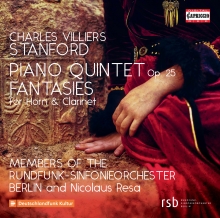
CHARLES STANFORD
MEMBERS OF THE RUNDFUNK-SINFONIEORCHESTER BERLIN
//
//
Quintet in D minor, Op. 25 for piano, 2 violins, viola and cello
Fantasy in A minor for horn, 2 violins, viola and cello
Fantasy No. 2 in F major for clarinet, 2 violins, viola and cello
MEMBERS OF THE
RUNDFUNK-SINFONIEORCHESTER BERLIN
NIKOLAUS RESA. Klavier / Piano (1-4) · DÁNIEL EMBER, Horn / horn (5)
CHRISTOPH KORN, Klarinette / clarinet (6)
ANNE FELTZ, Violine / violin I · BRIGITTE DRAGANOV, Violine / violin II
ALEJANDRO REGUEIRA CAUMEL, Viola · GEORG BOGE, Violoncello / cello
Nowadays William Stanford’s fame is largely based on his teaching activities in London while his reputation as a “great composer” has waned considerably. The list of his students reads like a veritable Who’s-Who of British music of the 19th and 20th century. Gustav Holst, Ralph Vaughan Williams, Arthur Bliss, Frank Bridge and several more were taught by Stanford. His œuvre covered a wide variety of sacred and secular music and his works carry within them elements of Irish folklore and mysticism. His many chamber works have a definite air of Brahms about them… never by way of direct quote or paraphrase, but by making Brahms’ style his own.
Hörprobe
Weitere Bilder

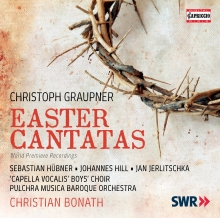
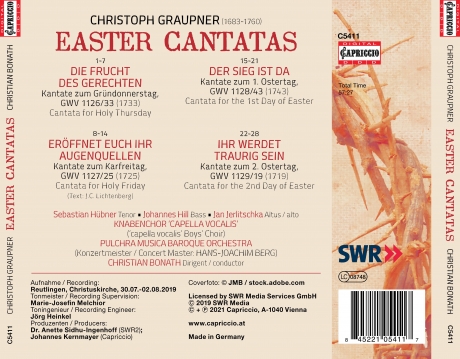
CH. GRAUPNER
Hübner · Johannes Hill · Jan Jerlitschka · capella vocalis Boys’ Choir · PULCHRA MUSICA BAROQUE ORCHESTRA · CHRISTIAN BONATH
Die Furcht des Gerechten
Kantate zum Gründonnerstag, GWV 1126/33 (1733) / Cantata for Holy Thursday
Eröffnet euch ihr Augenquellen
Kantate zum Karfreitag, GWV 1127/25 (1725) / Cantata for Holy Friday
Der Sieg ist da
Kantate zum 1. Ostertag, GWV 1128/43 (1743) / Cantata for the 1st Day of Easter
Ihr werdet traurig sein
Kantate zum 2. Ostertag, GWV 1129/19 (1719) / Cantata for the 2nd Day of Easter
In 1711 Graupner was already appointed court conductor and he would continue to work in Darmstadt for the rest of his life. Graupner’s focus shifted to sacred vocal music, which explains the sheer abundance of the 1,400-plus cantatas he composed. In 1723 the Leipzig city magistrates were looking for a new cantor at the Thomas School – and wanted him, above all. Alas, Graupner’s patron did not release him from his contract an so they had to hire Bach. Graupner, famous and widely celebrated during his lifetime, was soon thereafter forgotten. As we rediscover and hear more and more of his works, however, the judgement of his contemporaries would appear to us as increasingly germane. The present recording spans the liturgical arc from Maundy Thursday via Good Friday and Easter Sunday to Easter Monday and presents one liturgical work for each of the festive days – and each of them a world premiere recording!
Hörprobe
Weitere Bilder
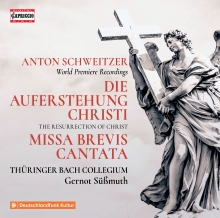
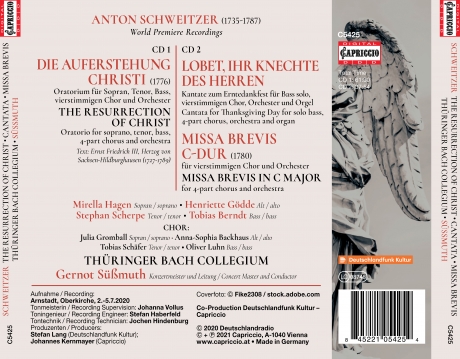
ANTON SCHWEITZER
Thüringer Bach Collegium · Gernot Süßmuth
Only few testimonies provide us any details about this now little known but once esteemed composer. Born in Coburg, 1735, Anton Schweitzer died 1787 in Gotha, where he had settled following the Weimar palace fire in 1774. Regrettably, only relatively few manuscripts have survived. Some of the works recorded here (which comprise almost the entire existing church music) have been preserved in several copies, which were recently found in different archives in Thuringia. This recording shows us a colorful virtuoso music of an unjustly forgotten composer.
Youtube
Weitere Bilder
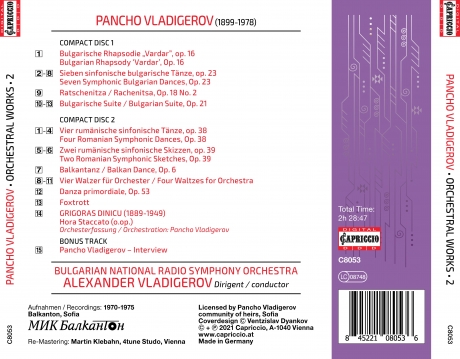
PANCHO VLADIGEROV EDITION: Orchestral Works 2
BULGARIAN NATIONAL RADIO SYMPHONY ORCHESTRA · ALEXANDER VLADIGEROV
[2] – [8] Seven Symphonic Bulgarian Dances, Op. 23
[9] Rachenitsa, Op. 18
[10] – [13] Bulgarian Suite, Op. 21
[5] – [6] Two Romanian Symphonic Sketches, op. 39
[7] Balkan Dance, op. 46
[8] – [11] Four Waltzes for Orchestra
[12] Danza primordiale op. 53
[13] Foxtrott
[14] Hora Staccato (o.op)
[15] Bonus-Track: Pancho Vladigerov Interview