cd

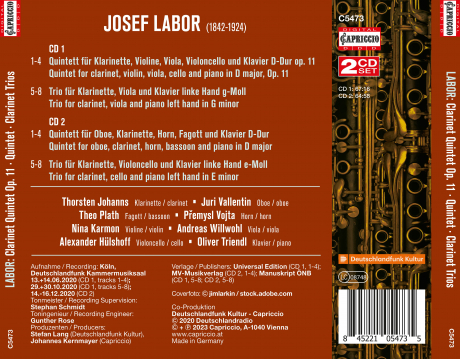
JOSEF LABOR: Clarinet Quintet
Johanns · Vallentin · Karmon · Triendl
The loss of one sense, it is said, makes the other keener. What the concert pianist, organist, and composer Josef Labor lost in eyesight when smallpox left him blind at age three, must have been added to his ears. Although roughly a Brahmsian (and a friend of the composer), Labor wrote in an original style, informed by his knowledge of and love for early music. As a piano teacher, he taught Arnold Schoenberg, Alma Schindler, and Paul Wittgenstein. The connection to the Wittgenstein family explains his many works for piano left hand, including the two Clarinet Trios on this set (the clarinet was Ludwig Wittgenstein’s instrument) which are coupled with his Clarinet- and his Wind Quintets.
Hörprobe
Weitere Bilder

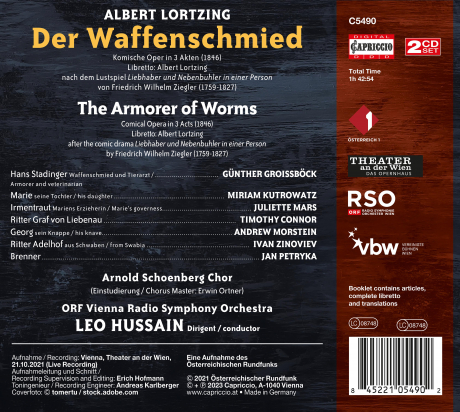
Lortzing: Der Waffenschmied
Arnold Schoenberg Chor · ORF Vienna Radio Symphony Orchestra · Leo Hussain
Lortzing’s Der Waffenschmied is a lighthearted and superbly crafted opera that bridges Mozart’s Singspiele and early Wagner. Despite its relative popularity, there are surprisingly few complete recordings of it around. How lovely to change that with this new recording from the very place for which the opera was written and where it was premiered in 1846: Vienna’s Theater an der Wien – and a wonderful cast that includes the stalwart Günther Groissböck and the supremely promising Miriam Kutrowatz to boot!
Hörprobe
Weitere Bilder
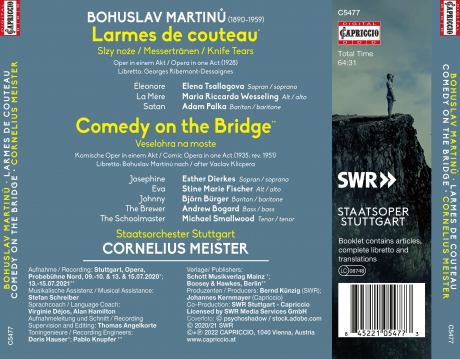
BOHUSLAV MARTINŮ: Larmes de couteau · Comedy on the Bridge
Elena Tsallagova Esther Dierkes · Björn Bürger · Staatsorchester Stuttgart · Cornelius Meister
Martinů is a musical chameleon. On the one hand, there’s an unmistakable from to his output, on the other hand, he would adopt and adapt just about any style that happened to be en vogue or to his liking. These two one-act operas, presented on record for the first time in their respective versions, are a case in point. There’s that cracking little shocker that is Knife Tears (in its original French version), in which Martinů set an absurdist libretto to the sounds of Le Jazz Hot, Stravinsky, and anything in between. This is juxtaposed with the English version of his Comedy on the Bridge (the one that helped this work to brief fame), which is wildly different (if anything more in the style of Hanns Eisler), despite being separated by a mere seven years.
Youtube
Weitere Bilder

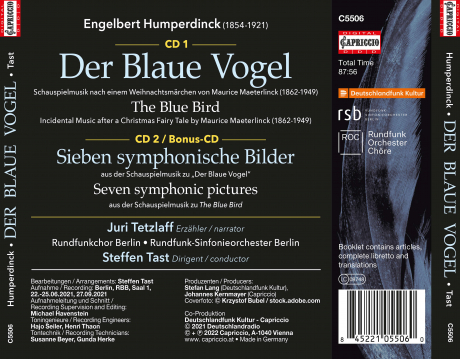
ENGELBERT HUMPERDINCK: Der Blaue Vogel
Juri Tetzlaff · Rundfunkchor Berlin · Rundfunk-Sinfonieorchester Berlin · Steffen Tast
In 1908, Maurice Maeterlinck wrote his play The Blue Bird (L’Oiseau bleu). Having proved a good source of operatic subjects before (Pelléas et Mélisande, Ariane et Barbe-Bleue), it is no surprise that composers jumped at the opportunity to write music to this latest. The French composer Albert Wolff made an opera of it that, though premiered at the MET, has since been forgotten. But even before that, in 1912, Max Reinhardt put it on as an adapted Christmas play in Berlin and he had none less than Engelbert Humperdinck write the incidental music to it. The music was never published until Steffen Tast found the score and salvaged it for us to hear. A sweet story and sweeter still music by Humperdinck newly discovered? Why, that’s in and of itself as though it was Christmas!
Hörprobe
Weitere Bilder

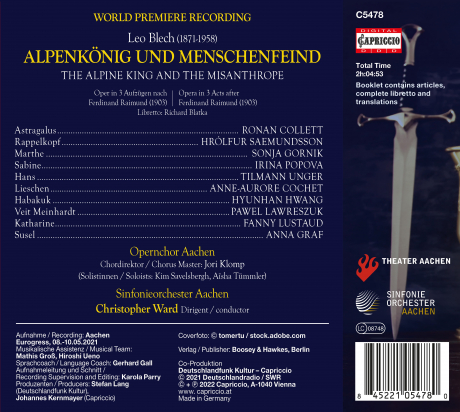
Leo Blech: Alpenkönig und Menschenfeind
Collett · Saemundsson · Opernchor Aachen · Sinfonieorchester Aachen · CHRISTOPHER WARD
Around 1902 Leo Blech nabbed the subject of the “original romantic-comic magic” play by Viennese theater manager/actor/playwright Ferdinand Raimund, had it streamlined, and turned it into his fifth opera. A cantankerous misanthrope terrorizes family and servants with his paranoid mistrust. He’s only cured when faced with his own behavior courtesy of supernatural role reversal. Highbrow opera meets folksy farce with unexpectedly gorgeous, splendidly orchestrated music somewhere between Wagner and Humperdinck. The premiere at the Dresden Court Theater was a sensational success. Then all of Blech’s music was banned and once the Nazi horror was over, it never came back. Now you can hear what we missed.