cd

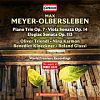
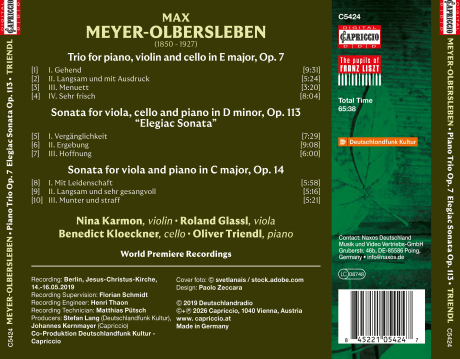
Max Meyer-Olbersleben
Nina Karmon · Roland Glassl · Benedict Kloeckner · Oliver Triendl
Max Meyer-Olbersleben, born in 1850 in Olbersleben, Thuringia, studied at the Weimar Orchestral School under Franz Liszt, and later at the Royal Music School in Munich under Gabriel Josef Rheinberger and Peter Cornelius. He settled in Würzburg as a professor of counterpoint and composition and served as director of the Royal Conservatory of Music until his retirement in 1920. During his lifetime, 114 works were published, primarily smaller forms such as choral works, songs, and piano pieces. Through his studies in Weimar and Munich, Meyer-Olbersleben was familiar with both the traditionalist and the new German musical language of that era, and thus the chamber music gems recorded here for the first time bear witness to profound Romantic sensibility and the spirit of a new musical awakening.
Hörprobe
Weitere Bilder

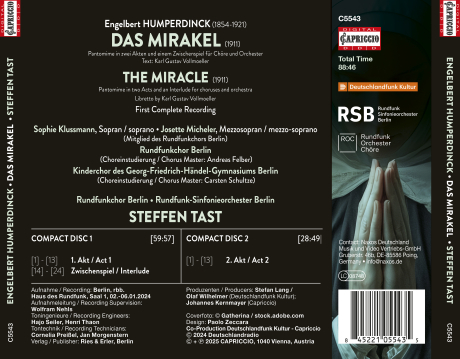
ENGELBERT HUMPERDINCK: The Miracle (1911)
Rundfunkchor Berlin · Kinderchor des Georg-Friedrich-Händel-Gymnasiums Berlin · Rundfunk-Sinfonieorchester Berlin · Steffen Tast
Pantomime in two Acts and an Interlude for choruses and orchestra
Libretto by Karl Gustav Vollmoeller
Engelbert Humperdinck's music for the pantomime of Karl Gustav Vollmoeller's arguably most important stage work impresses with its deeply Romantic sound and large-scale choral scenes and had so far led an unforgivable shadowy existence in the composer's oeuvre. Premiered in London in 1911, none other than Max Reinhardt adapted this work for film (1912) and staged numerous performances with hundreds of actors, singers, and dancers – finally also at the Salzburg Festival in 1925. This recording represents the first complete recording of this deeply Romantic masterpiece.
Hörprobe
Weitere Bilder

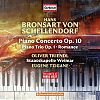
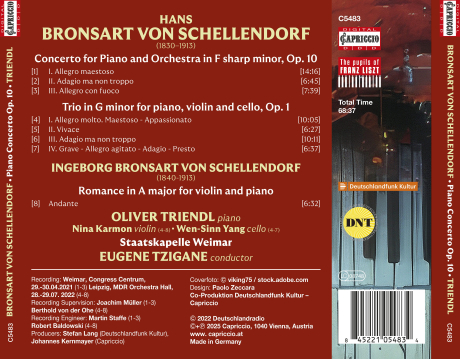
HANS BRONSART VON SCHELLENDORF
Oliver Triendl · Nina Karmon · Wen-Sinn Yang Staatskapelle Weimar Eugene Tzigane
Until recently, Bronsart von Schellendorf's career as a composer has been almost completely overlooked. But Liszt was aware of Bronsart’s prowess, referring to his orchestral work Frühlings-Fantasie as “beautiful and invaluable” and later declaring, “I value him as a character and a musician.” Even a cursory listen to the Piano Concerto reveals a composer working in ambitious dimensions and an extrovert musical language. Rich in melodic and emotional content, Bronsart’s piano writing gives ample opportunity for virtuoso display while delivering Bronsart’s musical arguments with power and precision. Bronsart's good friend Hans von Bülow, another pupil of Liszt, had toured the work from 1870 onwards. He took the concerto abroad, giving a concert in Manchester under the baton of Charles Hallé in 1877, by which time the work had secured a temporary foothold in the repertory.
Hörprobe
Weitere Bilder

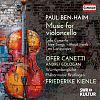
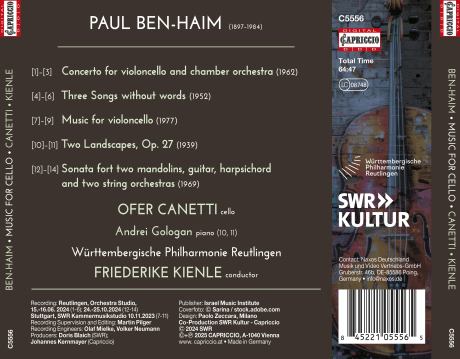
PAUL BEN-HAIM
Ofer Canetti · Andrei Gologan · Württembergische Philharmonie Reutlingen Friederike Kienle
Paul Ben-Haim ranks among those leading Israeli composers from his generation. Born Paul Frankenburger in Munich he studied composition with Friedrich Klose and served as an assistant conductor to both Bruno Walter and Hans Knappertsbusch. His extensive catalogue comprises works in all the primary genres apart from opera. Music for or with cello features prominently throughout Ben-Haim’s output. Following emigration, he increasingly advocated a specifically Jewish national expression while his own compositions favoured a late-Romantic vein redolent of – though by no means indebted (unlike other contemporaries) to – Ernest Bloch and frequently informed by Middle-Eastern overtones.
Hörprobe
Weitere Bilder
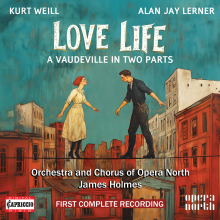
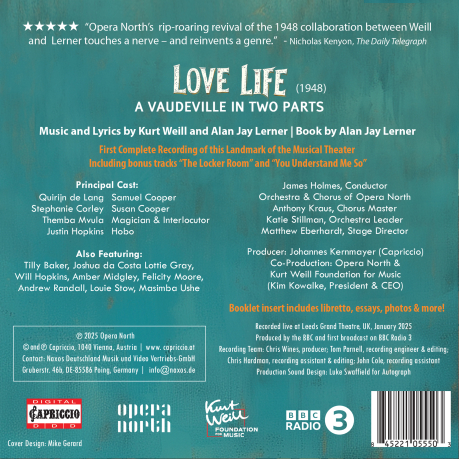
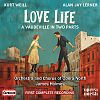
Kurt Weill - Love Life (1948)
Quirijn de Lang · Stephanie Corley · Orchestra and Chorus of Opera North · James Holmes
As a concept musical, Love Life was a real trailblazer, inspiring musical theatre favourites of the 1960s, 70s and beyond from Cabaret and Chicago (originally subtitled ‘A Musical Vaudeville’) to Sondheim’s Company (told through a series of vignettes). It is “one of Weill’s best scores” (conductor Jim Holmes), a masterpiece of putting different musical styles together, “a compendium of American musical idioms, cunningly chosen so that they suit the dramatic material”. Kurt Weill and Alan Jay Lerner teamed up in 1947, both riding high on recent successes (Street Scene for Weill, Brigadoon for Lerner) and looking for new projects. When Love Life premiered on Broadway in 1948, Weill called it “an entirely new form of theatre.” Stephen Sondheim denoted it as “a useful influence on my own work.”