cd
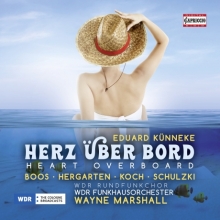
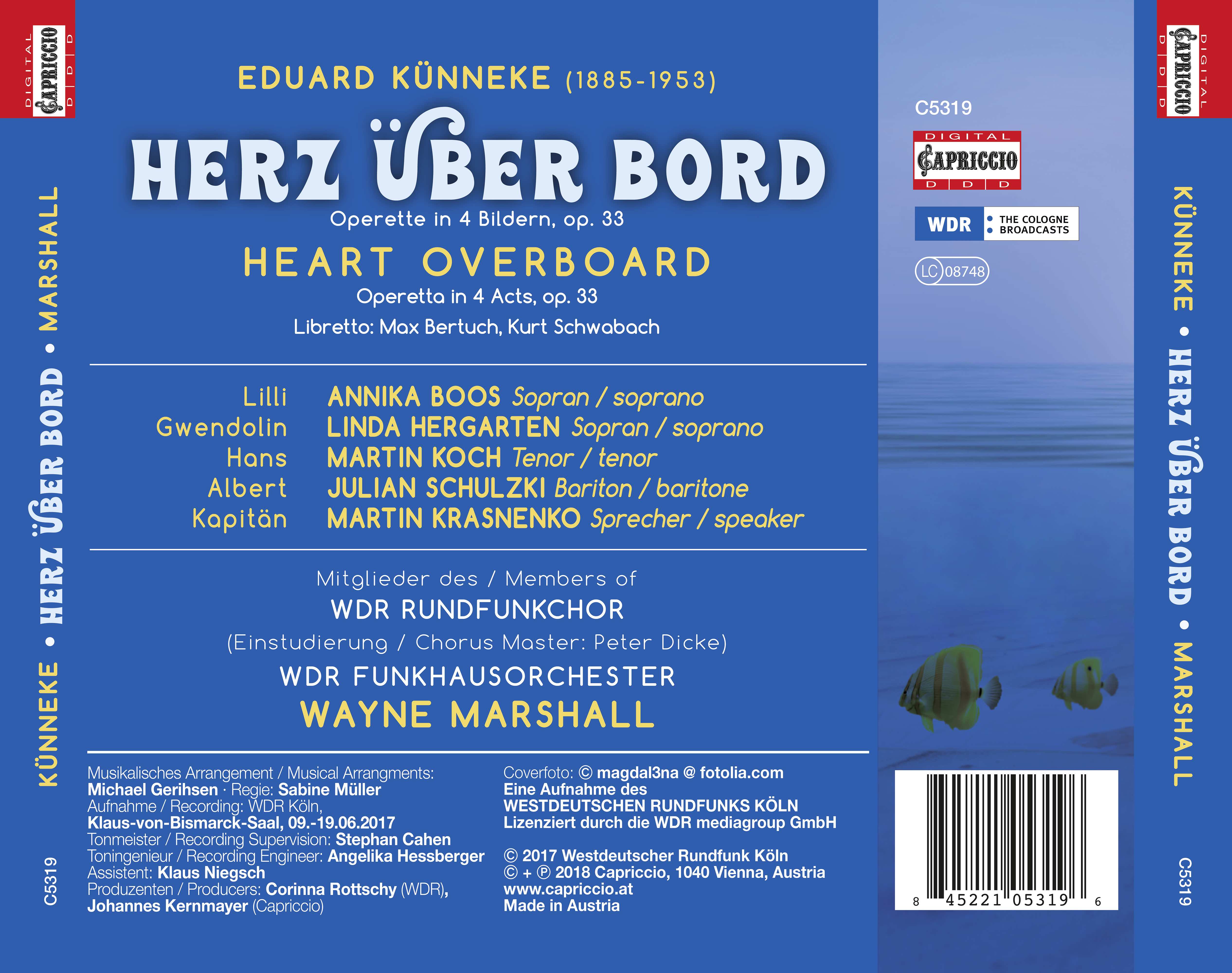
EDUARD KÜNNEKE: HERZ ÜBER BORD
WDR FUNKHAUSORCHESTER KÖLN WAYNE MARSHALL
Driven by success, Künneke committed himself to the genre of the operetta in the 1920s and 1930s. The diversity of his many operettas reveals Künneke’s enormous adaptability to the stylistic currents of entertainment music at that time. He had most international success with Der Vetter aus Dingsda (1921), with which Künneke has almost exclusively been identified up to today. His successful operettas were even adapted for London and New York. Herz über Bordwas premiered in 1935, initially at the Zurich Opera and was performed almost 500 times between 1935 and 1937, including in Dresden, Stuttgart, Stockholm and Berlin. The Berliner Zeitungnoted: ‘Once again, we can listen to operetta music written by an artist, a man of taste. Every number has its own weight’.
902
Weitere Bilder
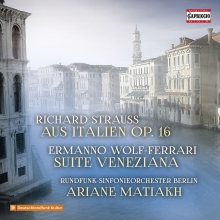
R. STRAUSS: Aus Italien · WOLF-FERRARI: Suite Veneziana
Ariane Matiakh
‘Never have I really believed in inspiration by the beauty of nature; I was put right by the ruins of Rome. There my ideas just flew to me.’ Richard Strauss
"Aus Italien"was the first major symphonic poem mirroring diverse moods to be composed by Richard Strauss and that was to be followed by later masterpieces such as Don Juan, Tod und Verklärung, Ein Heldenleben or Eine Alpensinfonie. The Venetian Suite was written in 1935 by then almost 60-year-old Ermanno Wolf-Ferrari. It is the music of an opera composer, accustomed to illustrating events with his music, and yet in his concert works handing over many things to the imagination of the listeners, not wanting to give all the answers in advance.
Weitere Bilder
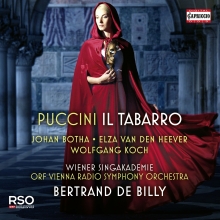
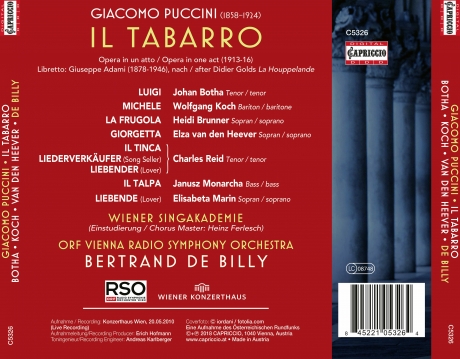
GIACOMO PUCCINI: IL TABARRO
WIENER SINGAKADEMIE · ORF VIENNA RADIO SYMPHONY ORCHESTRA · BERTRAND DE BILLY
Opera in un atto / Opera in one act (1913-16)
Libretto: Giuseppe Adami (1878-1946) nach / after Didier Golds „La Houppelande
LUIGI: Johan Botha, Tenor / tenor
MICHELE: Wolfgang Koch, Bariton / baritone
LA FRUGOLA: Heidi Brunner, Sopran / soprano
GIORGETTA: Elza van den Heever, Sopran / soprano
IL TINCA / LIEDERVERKÄUFER (Song Seller) / LIEBENDER (Lover)
Charles Reid, Tenor / tenor
IL TALPA: Janusz Monarcha Bass / bass
LIEBENDE: Elisabeta Marin, Sopran / soprano
WIENER SINGAKADEMIE
(Einstudierung / Chorus Master: Heinz Ferlesch)
ORF VIENNA RADIO SYMPHONY ORCHESTRA
BERTRAND DE BILLY, Dirigent / conductor
With "Il tabarro" Puccini wrote the first part of his projected opera triptych, with which he ultimately intended to parody and reverse Wagner’s Ring tetralogy by stringing together three completely incoherent short stories. Once more, for Il tabarro the composer virtually emigrated to France, to which he had already made declarations of love with La Bohème and Manon Lescaut. This affinity is now mirrored more clearly than in these two operas in the music of The Cloak, which emanates French, well-nigh Impressionist perfume. Bertrand de Billy knows how to make the the score alive with a fantastic cast on his side. World famous tenor Johan Botha was on the top of his carreer.
Youtube
Weitere Bilder
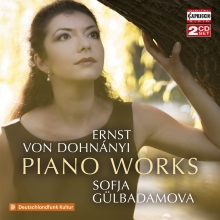
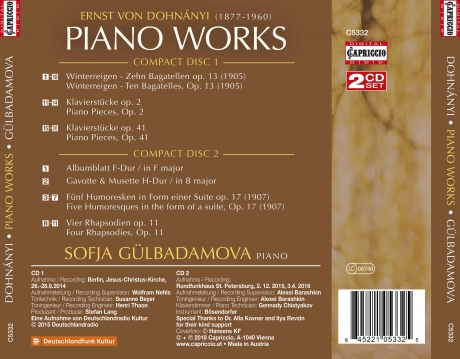
ERNST VON DOHNÁNIY (1877 - 1960)
SOFJA GÜLBADAMOVA, Klavier / piano
Dohnányis Piano works are influenced of the late romantic aera, with different character pieces formed as a cycle like the late piano works of Brahms.
Sofja Gülbadamova, prizewinner of many international competitions, is being highly acclaimed for her poetic interpretations, profound musicality as well as astonishingly varied sound palette. Since many years she take care of Dohnányis piano Oevre.
Weitere Bilder
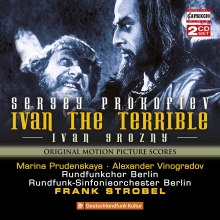
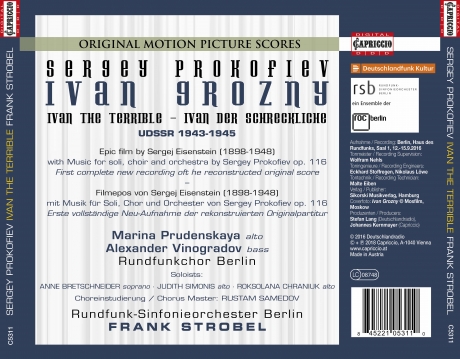
PROKOFIEV: IVAN THE TERRIBLE
MARINA PRUDENSKAYA, alto · ALEXANDER VINOGRADOV, bass · RUNDFUNKCHOR BERLIN · RUNDFUNK-SINFONIEORCHESTER BERLIN · FRANK STROBEL
(UDSSR 1943-1945)
Epic film by Sergej Eisenstein (1898-1948)
with Music for soli, choir and orchestra by Sergey Prokofiev op. 116
First complete new recording oft he reconstructed original score
IVAN THE TERRIBLE – the second joint project of Sergei Eisenstein and Sergei Prokofiev – is, much like ALEXANDER NEWSKI, a historical epic, portraying the rise and fall of the autocratic ruler Ivan IV in the 16th century. Sergei Prokofiev’s musical portrayal is unique in film history, for the score conceives both parts of the film on an epic scale. Prokofiev’s rich melodic invention thrives on the expressive sound palette of his native Russia, mostly as they echo the spiritual works of the Russian-orthodox liturgy.